Private Tokyo Ghost Tour: A Haunted Night Walk Through Shinjuku
Some of the ghosts on this walk are folklore. The rest are matters of public record, and those are the frightening ones.Key Facts
Overview
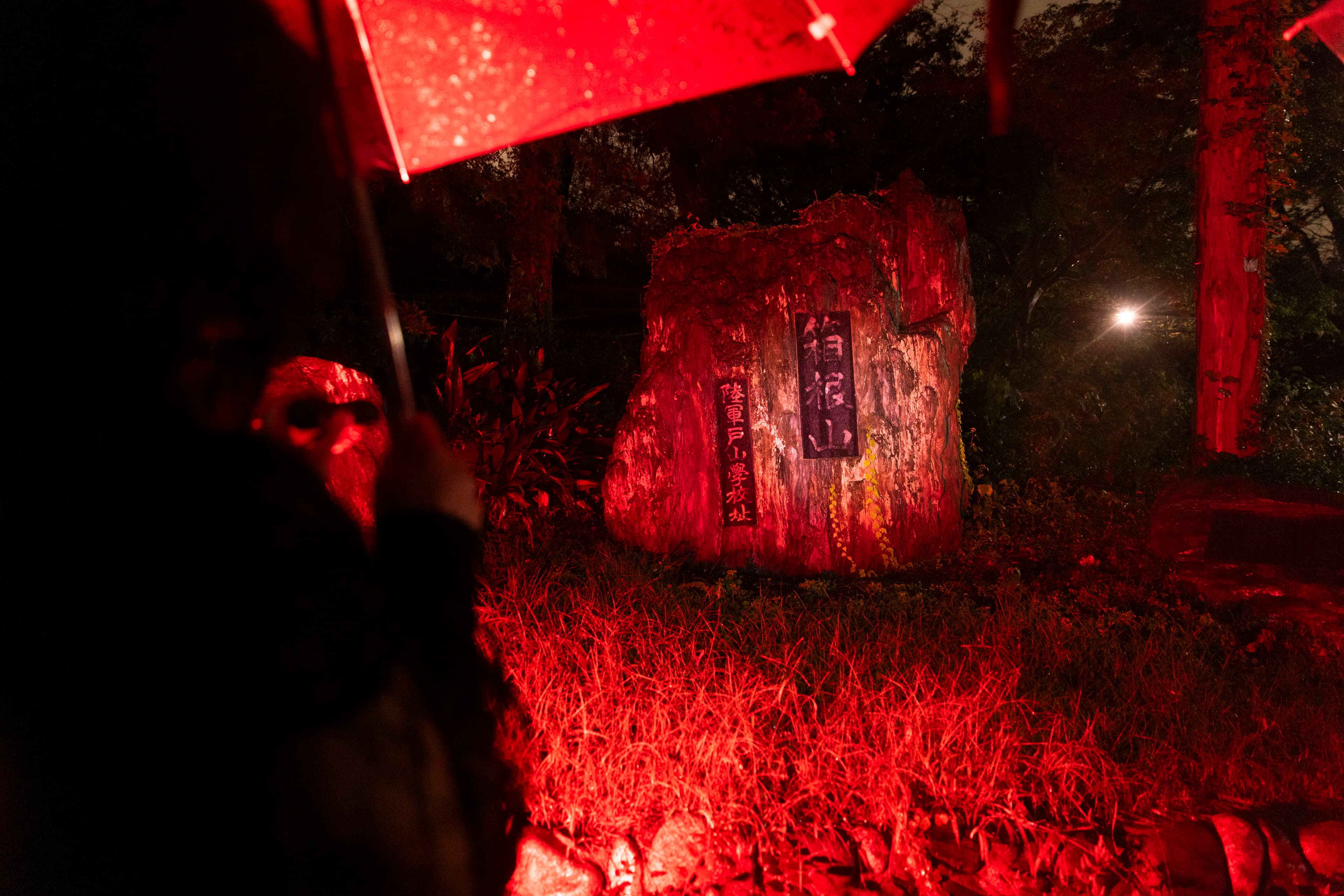
At 44.6 meters, Hakoneyama is the highest point in Tokyo’s 23 wards. But it is not really a hill. It was built by hand in the 1670s, when earth was piled up to give a feudal lord a better view across his garden.
Two centuries later the army took the land, and the mound looked down on the Army Medical School. A nurse testified that specimens were buried there at the end of the war, to hide them from the occupation. Construction found them in 1989.
On this private Tokyo ghost tour, you will climb Hakoneyama after dark. There is a rumor that a voice can be heard counting numbers here at night. Your Local Expert knows the story, and the history behind it.
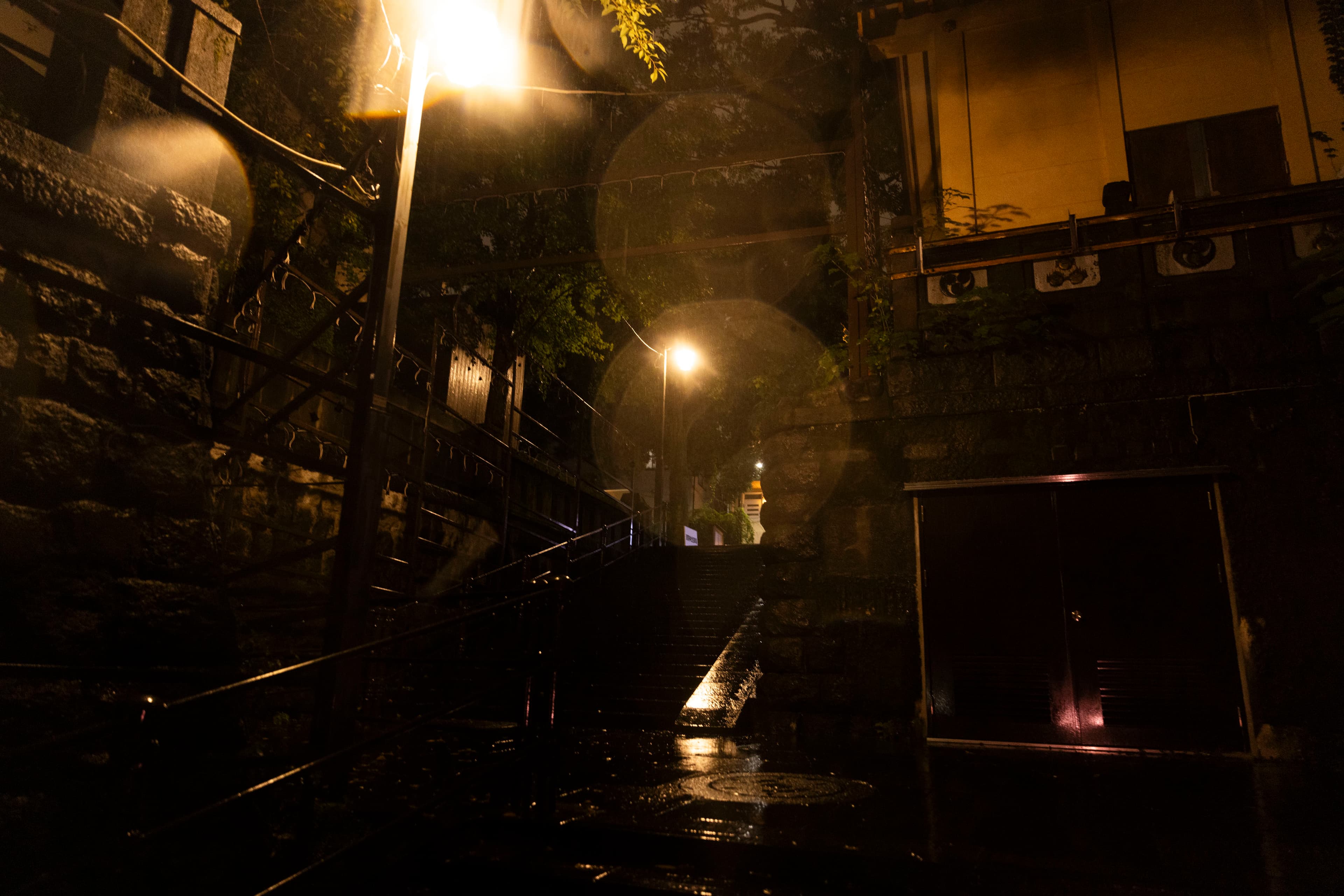
The same pattern runs all night. A children's playground sits on an execution ground. A lane packed with izakaya was once a geisha quarter, where the names of houses that disappeared long ago can still be found carved into the pillars of a shrine.
As a private tour, you can follow the stories that catch your attention. Ask questions, stay longer where something grips you, and leave with recommendations for what to explore next in Tokyo.
Where we'll meet
What You Could Do
Every TOMOGO! tour is led by a local expert, so the exact route may vary depending on the day, group interests, weather and what is happening in and around the city. Think of this as a glimpse of what your Tokyo adventure could possibly include.
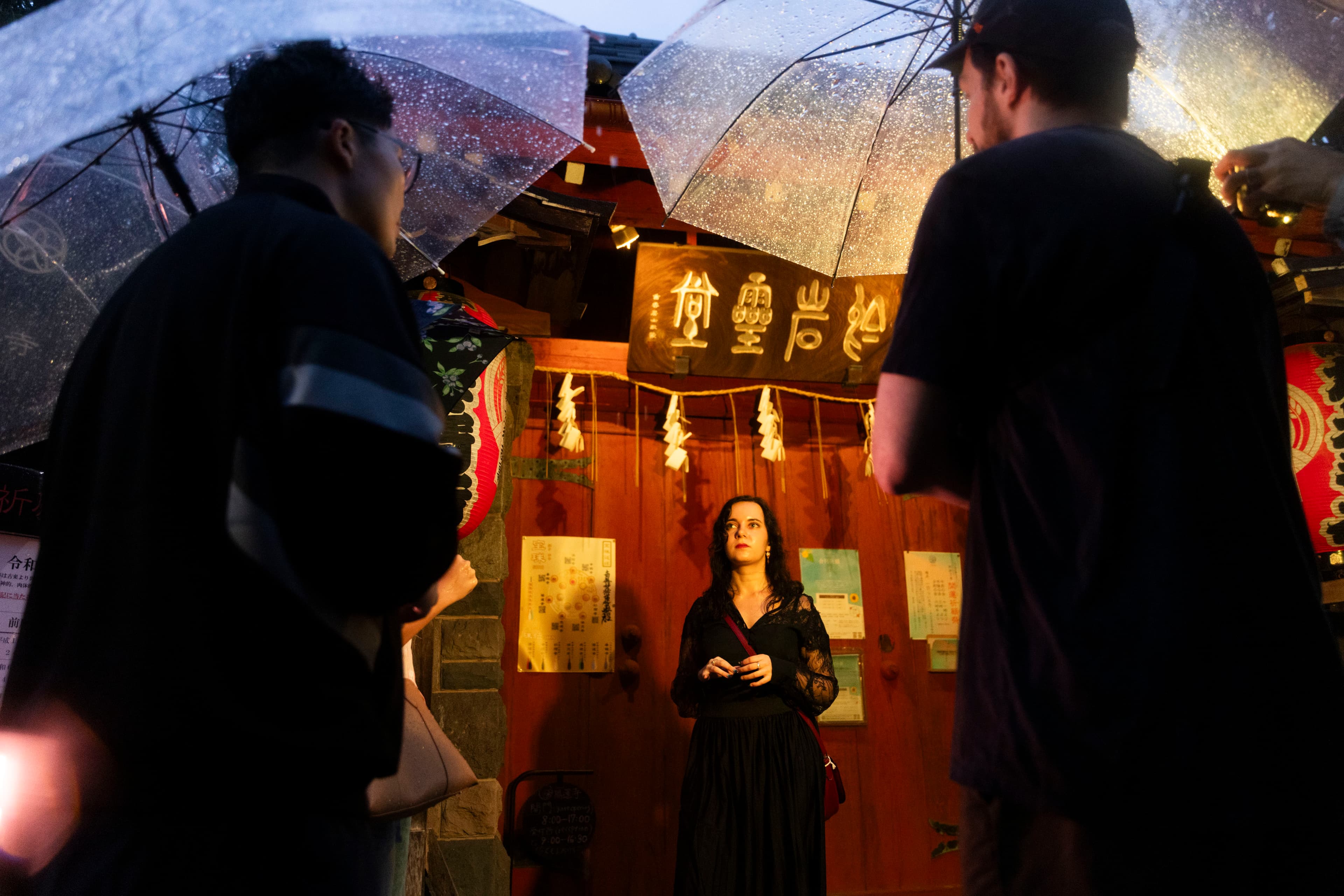
The story has followed the shrine ever since. Even today, casts preparing to perform Yotsuya Kaidan are said to visit first and pay their respects, wary of stories of accidents befalling productions that do not.
Then look across the lane. Oiwa has another place waiting for her there: a Buddhist temple with its own claim to her story.
But old ponds came with stories. This one had a kappa. People believed the creature waited at the water’s edge, ready to drag the unsuspecting in and steal their soul. When bodies were pulled from the water, what people saw only seemed to give the stories more weight.
Just ahead, you will meet a very different version of that creature: the cheerful green kappa that now watches over the slope. It is a much friendlier face for a legend that began with something considerably darker.
You can still find traces of that past at Kanamaru Inari Shrine. Look closely at the stone pillars surrounding it and you will see the names of geisha houses that once filled these lanes. Most have long since disappeared, leaving the shrine as an unexpected record of a neighborhood that has almost vanished with them.
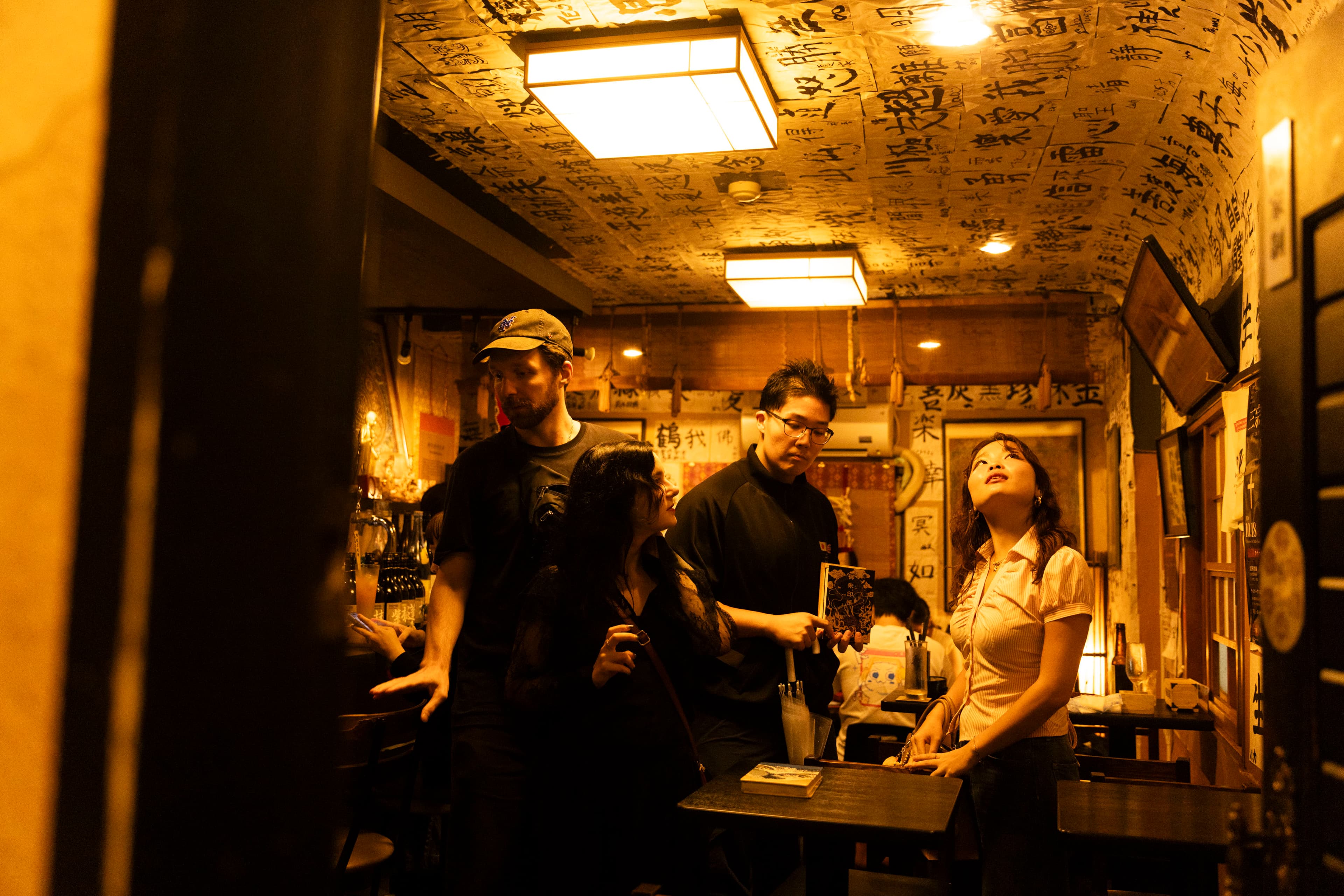
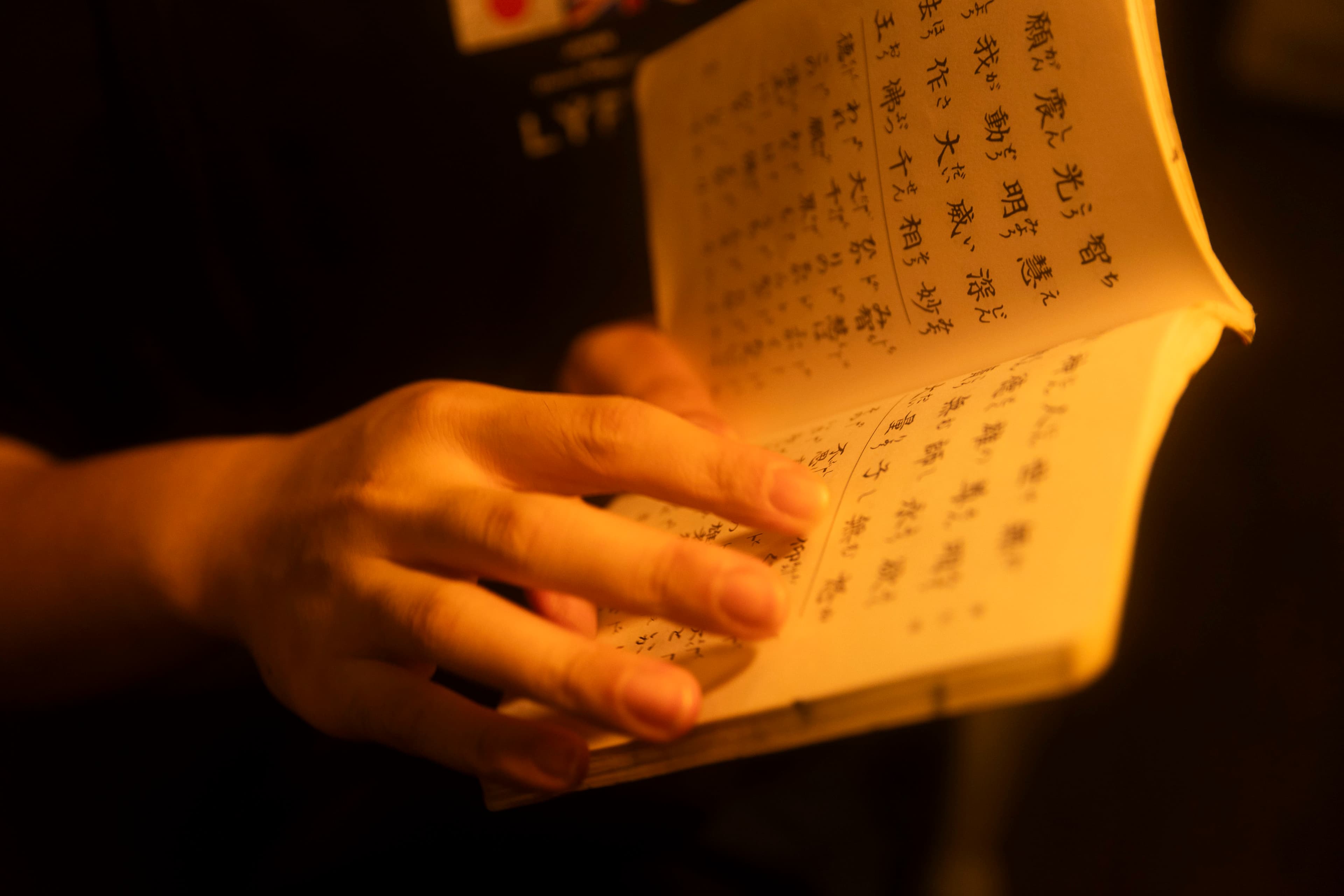
A few doors down, the street takes another turn. Vowz Bar is run by Buddhist monks. Take a seat, order a drink with a Buddhist-inspired name, and try copying a character from a sutra by hand.
At Setsubun the rest of the country chants for demons out; this shrine calls them in. You end under the guardian monster, with recommendations for the rest of your trip.
Tour Reviews
No Tour Reviews Available
Included / Not Included
Meet your Local Expert outside the Ministop outside Shinanomachi Station, at the main ticket gate on the JR Chuo-Sobu Line. The station is two stops from Shinjuku and one from Yotsuya, and the walk begins immediately on the backstreets heading northwest.
Start times move with the sunset, because the route is paced so you reach the Hakoneyama summit at the darkest point of the night. Expect roughly 6:00pm - 7:00pm in winter and 7:30pm - 8:30pm in midsummer, confirmed with you when you book. One scheduling note: Vowz Bar is closed on Sundays and national holidays, so on those nights your local expert will route around it.
The tour typically runs around 3 hours, though this can vary depending on your pace, interests, and how long you stick around at each stop. As a private tour, there's no set route, so if you want to spend more time somewhere, just let your tour leader know.
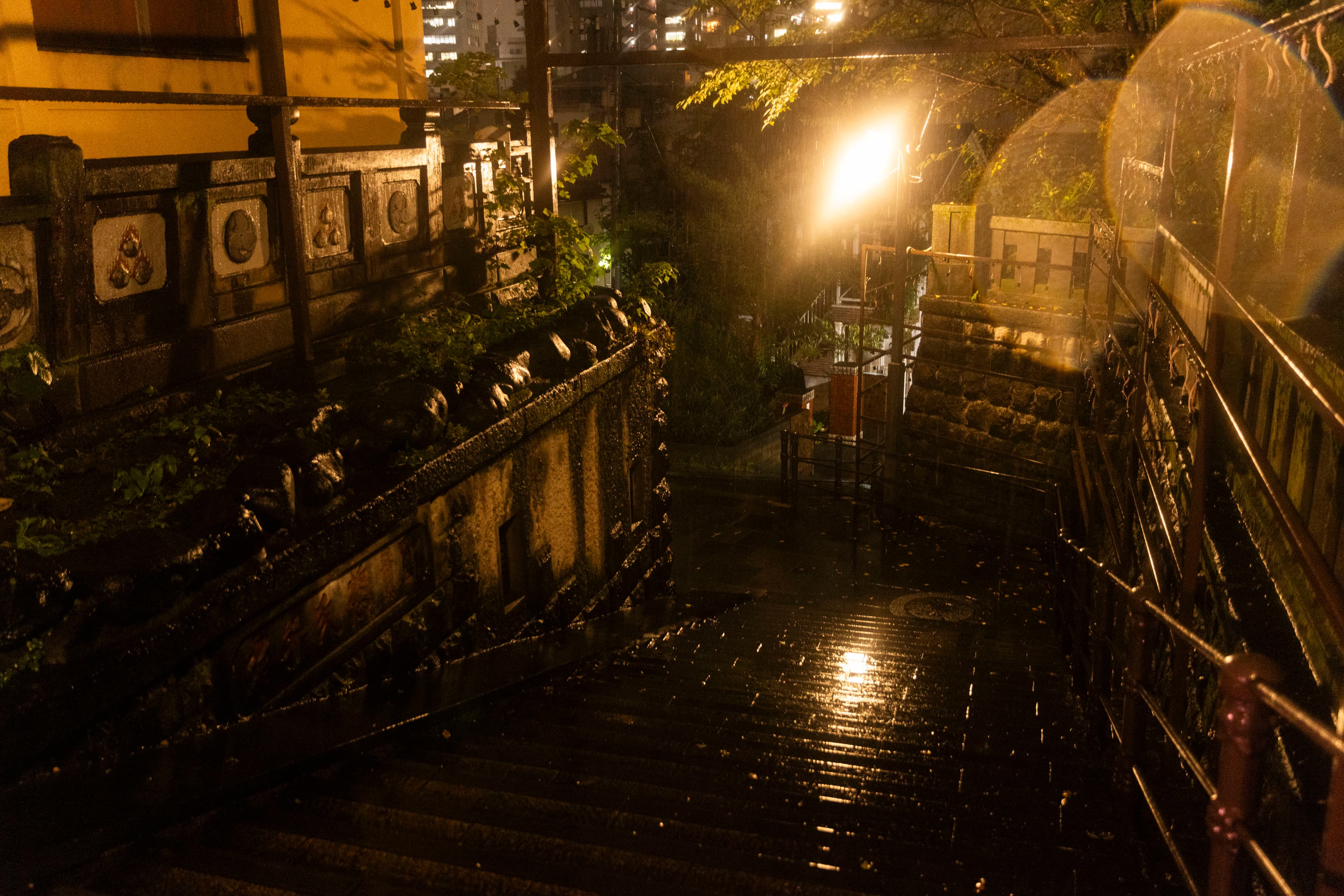
Less than the length suggests. You'll cover roughly 3 to 4 kilometers on foot, broken up by a seated stop at Vowz Bar and a short bus ride north, so the walking arrives in sections rather than one long push. Most of it is flat backstreet. The exceptions are Arakicho, which sits in a valley and involves slopes, and the final climb up Hakoneyama, which is an unlit stone and earth path. Comfortable shoes for walking in are strongly recommended.
This is a completely private tour. Just you, your travel companions, and your tour leader. You won't be joined by strangers, and the experience is tailored entirely to you. This means you can set the pace, ask questions freely, and adapt the route as you go.
Not necessarily, and that's by design. Every TOMOGO! tour is led by a local expert, so the route may shift depending on the day, the weather, what's happening in the neighborhood, and your personal interests. The itinerary on this page is an example of what your tour could include. Talk to your local expert during the booking process if there are specific things you're hoping to see.
It is unsettling rather than frightening. There are no actors, no jump scares and nothing staged. The walk runs on quiet backstreets in full dark, and most of what makes it land is that the history is real. The heaviest stops, the execution district and the Toyama war dead, are handled as remembrance and include a genuine minute of silence at the summit. If you are looking for a haunted house, this is not it.
Some are documented history, some are folklore, and some are rumor. Your Local Expert names which it is before telling it.
The remains found during construction near Toyama Park in 1989 and the executions at Ichigaya prison are matters of record. Oiwa's curse and the kappa in the pond are folklore, and the tour explains where each one came from.
The voices reported on the Hakoneyama summit are rumor, and get called rumor out loud. A good example of the difference: people often say the remains were hidden inside Hakoneyama, or that the mound was thrown up after the war to cover them. Neither is right. The mound is a 1670s garden feature and the remains came out of a construction site at its foot in 1989. The real sequence, a pleasure hill that watched an army arrive beneath it, is stranger than the version online, and the tour prefers it.
Partly, and it is worth raising at booking. Most of the route is flat backstreet, and the seated stop and the bus leg mean the walking is less continuous than 3 hours implies. The two hard sections are Arakicho, which sits in a bowl and involves slopes, and the Hakoneyama climb, which is a stone and earth path in the dark with no lighting and no handrail. Your local expert can wait with the group at the base of the hill or walk the flat park loop instead. The tour is not suitable for wheelchair users.
No. This is an adults-only tour, 20 and over. The route includes a seated stop at Vowz Bar, a bar in Arakicho run by Buddhist monks, and Japan's legal drinking age is 20, so under-20s cannot join. The rest of the night is built for adults too: it runs in full dark, covers real executions and wartime human remains, and finishes with a climb up an unlit hill. If you are traveling with under-20s, get in touch and we can suggest another TOMOGO! tour that suits the whole group.
No. Your local expert carries one, and it is mandatory for the Hakoneyama climb, so the group is covered. That said, a phone light is useful on the unlit slopes in Toyama Park and on the uneven ground in Arakicho, and worth having if you are unsteady on your feet.
Wear everyday, casual clothing suitable for walking in. Comfortable shoes are essential. If you're visiting in summer, Japan can be very hot and humid, so be sure to dress lightly and consider a sun hat. In the rainy season (roughly June to mid-July), a compact umbrella or lightweight rain jacket is worth bringing. Layers are useful in spring and autumn when temperatures can drop in the evening.
Yes. As Japan remains a largely cash-based society, many of the smaller venues in Shinjuku do not accept cards. We recommend carrying at least ¥3,000-¥5,000 for optional food, drinks, or souvenirs during the tour. It's also possible to stop by an ATM to get cash while on tour. For international cards, ATMs at 7-Eleven and Japan Post are the most reliable.
One drink at Vowz Bar is included with the tour. Beyond that, food and drinks are not included. We recommend bringing cash if you'd like to stop at a local café, bar, snack store, or restaurant during the tour to order and pay for any food or beverages you choose.
The tour is a fully private, guided walking experience through a mix of Shinjuku's most interesting and lesser-known areas. The itinerary is completely customizable, but can, for example, include stops at Oiwa Inari Tamiya Shrine, Suga Shrine, the Saku-no-ike kappa pond, and the Hakoneyama summit in Toyama Park. During the tour, your local expert will share local stories and history at each stop. They will also provide personalized recommendations for the rest of your time in Tokyo. Entrance fees, food, drinks and transport are not included unless otherwise stated at booking.
Yes you can! This is one of the main benefits of a private tour. Whether you're interested in Edo folklore, wartime history, Buddhist practice, or Old Shinjuku's quieter corners, let your tour leader know and they'll adjust accordingly. If you have specific questions or places in mind, make sure to share them when you book.
Yes, Shinjuku is easy to explore on your own, but having a Local Expert helps you discover local stories and experience the area beyond just walking through it.
Plenty, and your local expert will point you at the ones near you. Tokyo alone has Taira no Masakado's grave in Otemachi, the Kanda Myojin shrine that enshrines him, and Aoyama Cemetery. Beyond the city, Aokigahara at the foot of Mount Fuji and Osorezan in Aomori are the two most often named. Ask on the night and you will get suggestions that fit your route rather than a list off the internet.
The tour runs in light rain, though this route has less shelter than most of ours. Toyama Park and the Hakoneyama path are open ground and the stone steps get slippery, so bring an umbrella and shoes with grip. Your local expert will reorder the route to put the seated stop at Vowz Bar where it helps most. In the event of severe weather (such as a typhoon warning), we will contact you as early as possible to discuss rescheduling or a refund.
Absolutely. This is a core part of what the tour is for. By the end you'll have a clearer sense of where everything is, what's worth coming back to, and how to enjoy Shinjuku on your own terms. Your local expert will give you personalized suggestions based on what you enjoyed most during the tour.
Yes. TOMOGO! tours are available in 27 languages, though availability varies by tour and also depends on which local experts are based in each area. Use the language selector when booking to check availability for this tour. If your preferred language isn't available, contact us and we'll do our best to help.
Plans change, we get that. Please contact us as soon as possible if you need to cancel or reschedule. Our tours come with free cancellation and rescheduling up to 24 hours before the scheduled start time. Cancellations or changes requested within 24 hours of the start time are non-refundable and will not be accepted. All deadlines are based on the local time of the experience.
Yes. Each TOMOGO! tour leader is a local who genuinely knows the area. Not just the landmarks, but the stories, the backstreets, and the kind of insider knowledge that doesn't show up in travel guides. That local perspective is central to what makes TOMOGO! tours worthwhile.
Tipping is not expected or required. As it's not a common custom in Japan, your tour leader won't be anticipating it. That said, if you had a great time and want to show your appreciation, it's always welcome and will mean a lot.
If you enjoyed this tour and want to explore more of Japan with a local expert, we have tours running across Tokyo, Osaka, Kyoto, Nara, Kawagoe, Kanagawa and more. New destinations are being added all the time. Check out our tour page for more details.