
Haunted Tokyo: 5 Ghost Stories Hiding Beneath the Modern City
Tokyo is very good at looking new.
Glass towers rise over neighborhoods that have existed for centuries. Train lines cut across the city. Convenience stores stand around the corner from shrines older than the streets surrounding them.
But underneath modern Tokyo is Edo. And Edo left behind more than temples and old street names.
The city burned repeatedly. It survived earthquakes, floods and outbreaks of disease. There were samurai estates, execution grounds and countless lives that ended suddenly or violently.
As Tokyo rebuilt, the city changed, but the stories attached to those places did not always disappear with it. That is where Tokyo's ghost stories start to show themselves.
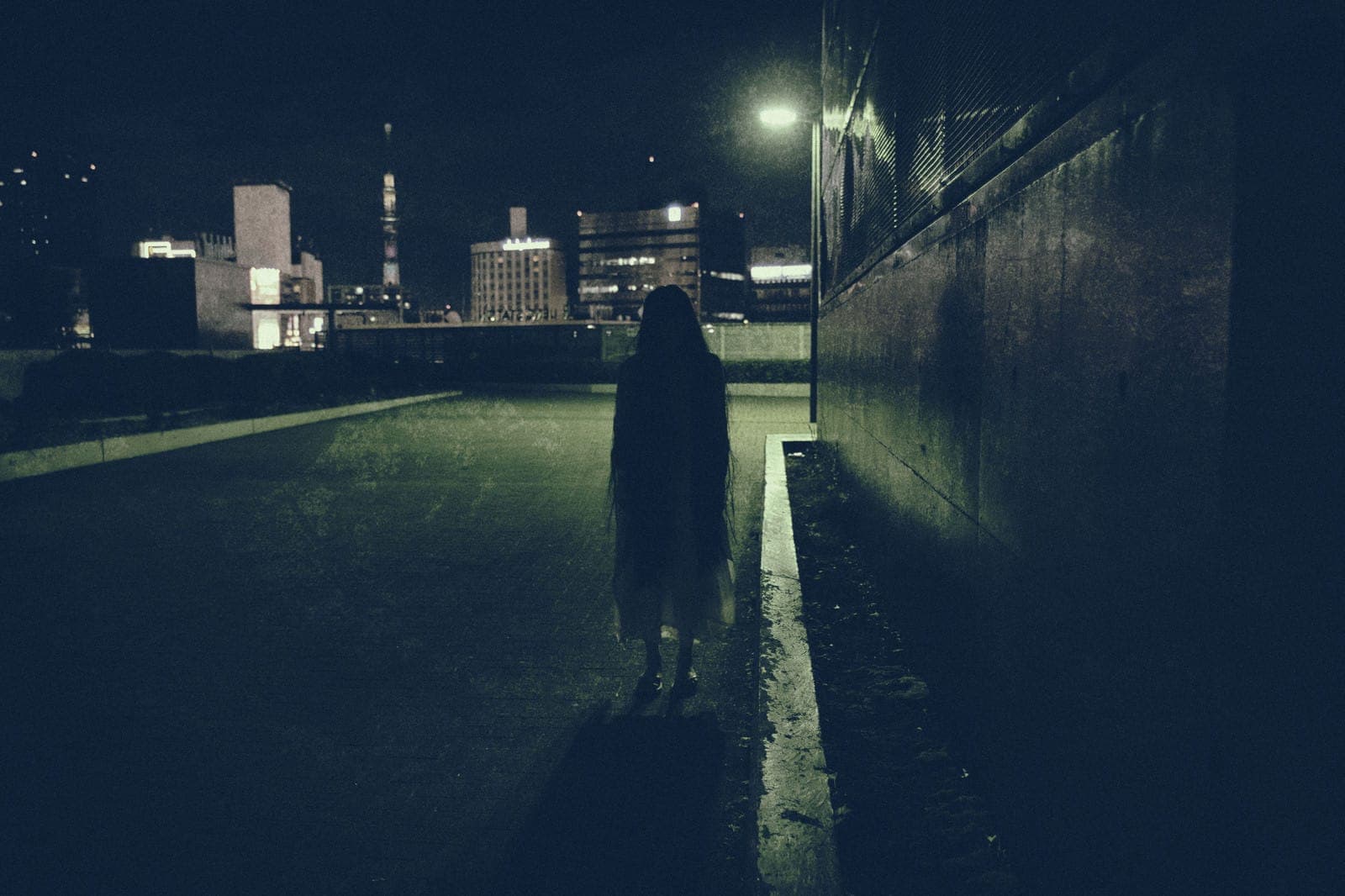
Japanese ghosts, or yurei, are often connected with people who have not moved on peacefully into the afterlife. A violent death, unfinished business, resentment or a powerful attachment can all keep a spirit around. Other stories belong to creatures that were never human in the first place, lurking in old ponds, rivers and forgotten corners of the city.
Some ghosts are folklore, others begin with very real history.
From a vengeful woman who became one of Japan’s most famous ghosts to a severed samurai head with some surprisingly expensive real estate, here are five Tokyo ghost stories still hiding beneath the modern city.
Oiwa: The Ghost That Made Yotsuya Famous
If you only learn the name of one Tokyo ghost, make it Oiwa.
Her story was immortalized in the 1825 kabuki play Tokaido Yotsuya Kaidan. In its best-known version, Oiwa is married to Iemon, a samurai who wants to leave her for another woman. Oiwa is poisoned and horribly disfigured. She dies, but does not leave Iemon behind. Instead, she returns as an onryo, a vengeful spirit. Her face appears where it should not. Iemon begins seeing her everywhere, and the people around him start to die.
The irony is that the real Oiwa seems to have been remembered for almost the exact opposite reason. A very different version of Oiwa survives in the tradition of Oiwa Inari Tamiya Shrine. Here, Oiwa and Iemon are described as a happily married couple who restored the fortunes of the Tamiya family. Oiwa was devoted to the small Inari shrine on their property, which became known locally as Oiwa-san’s Inari.
Somewhere along the way, the story changed.
By 1727, a much darker version of Oiwa’s story had appeared in Yotsuya Zodanshu, an anonymous collection of Edo-period rumors that worked a little like tabloid gossip of the time. In this version, Iemon abandoned Oiwa for another woman. Oiwa disappeared, and one by one, 18 people connected to Iemon were said to have died unnatural deaths.
Writers picked up the story and added to it. Then, in 1825, playwright Tsuruya Nanboku IV turned those rumors into Tokaido Yotsuya Kaidan. The betrayed wife became a poisoned, disfigured ghost, and Oiwa’s second life began.
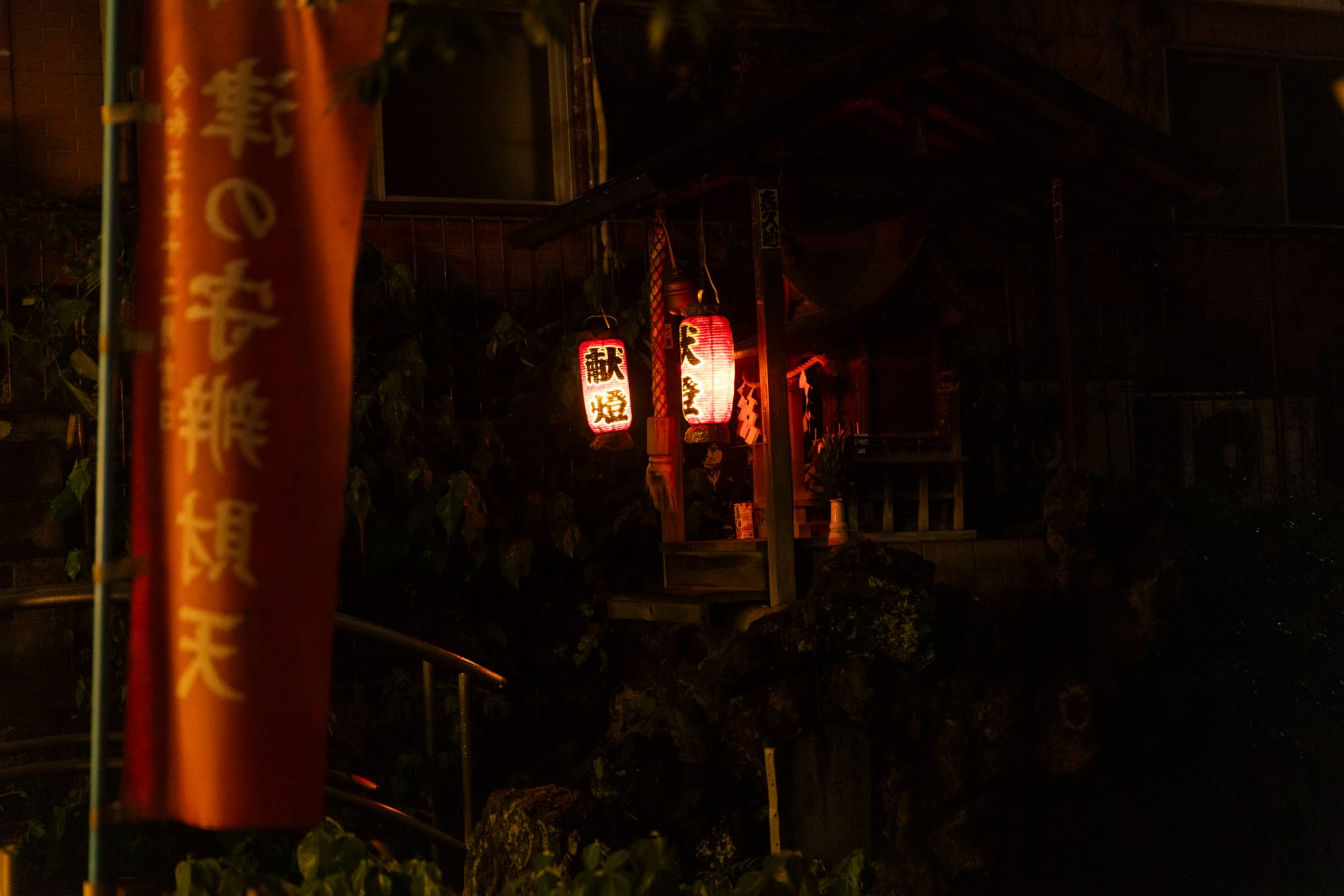
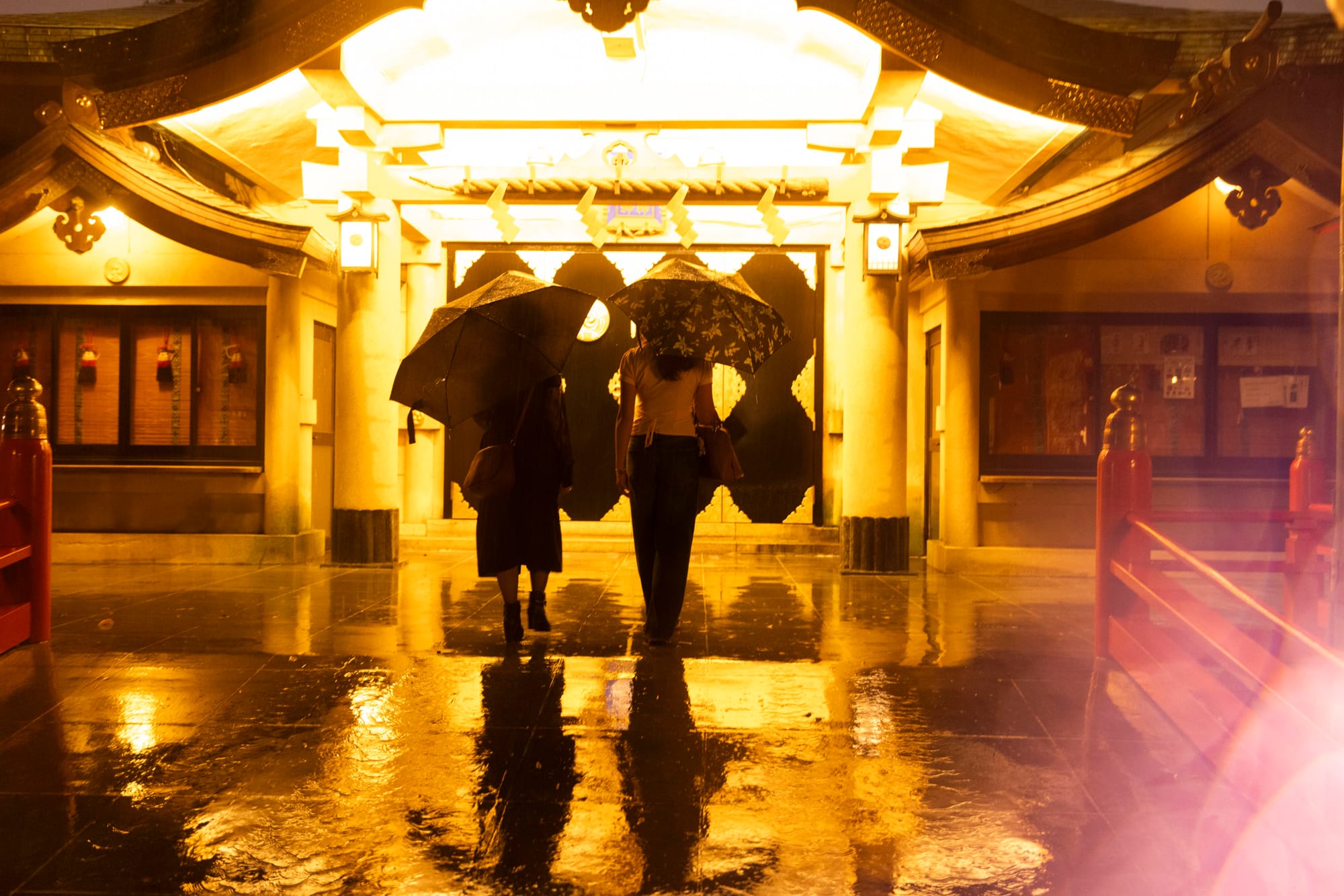
You can still find Oiwa Inari Tamiya Shrine in Yotsuya today, close to where the Tamiya family once lived.
The real Oiwa became known for bringing her family good fortune. The fictional Oiwa became famous for destroying it.
Want to Hear Tokyo’s Ghost Stories After Dark?
Reading stories is one thing. Walking the streets they are attached to is another.
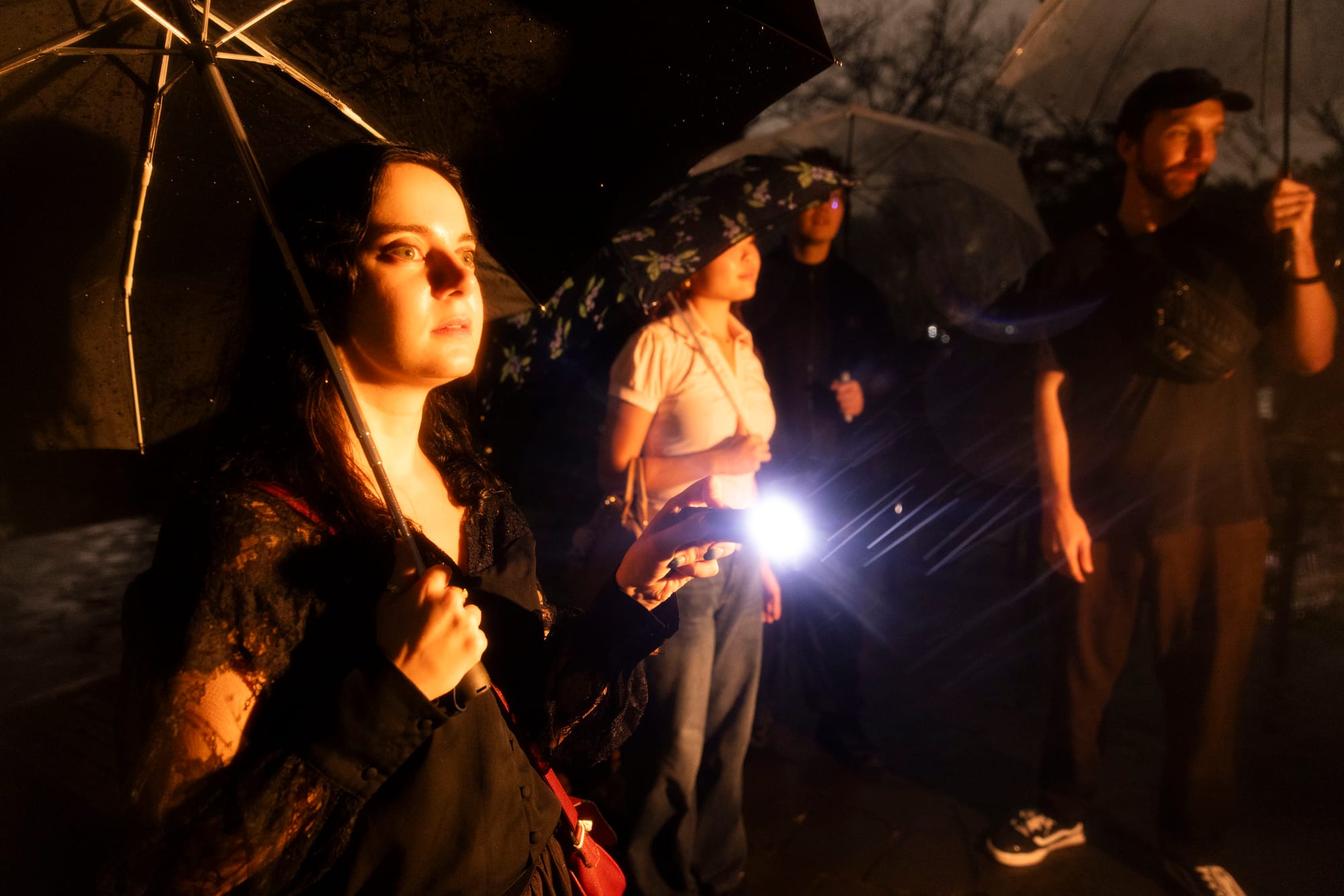
On the TOMOGO! Tokyo Ghost Tour, a Local Expert takes you through the city after dark, connecting strange local legends with the real history behind them.
Saku-no-ike: The Kappa Pond Hiding in Arakicho
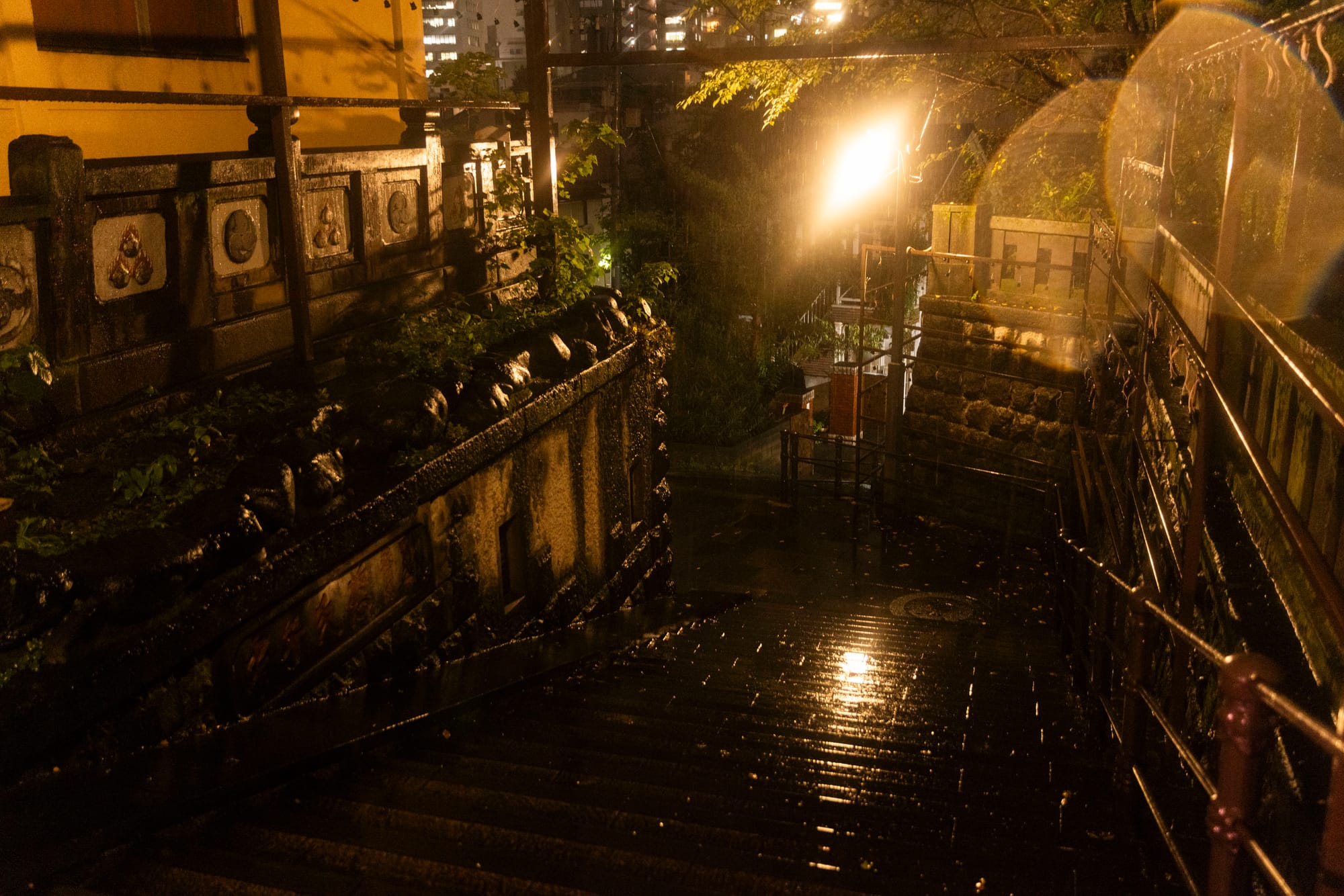
From the main road, Arakicho looks fairly flat. Yet, walk into its backstreets and the ground suddenly drops away. Stone steps and narrow lanes lead down into a bowl-shaped valley, with a small pond sitting at the bottom.
This is Saku-no-ike, and it used to be much bigger.
During the Edo period, the area was home to the upper residence of the Matsudaira family, lords of the Takasu Domain. Their garden had a large pond fed by spring water and a waterfall around four meters high. After the garden opened to the public in the Meiji period, the pond and waterfall became a popular scenic spot. Teahouses and restaurants followed, and the surrounding streets eventually developed into a geisha district.
The pond also became associated with a kappa, one of Japan’s best-known supernatural creatures.
That was not necessarily something you wanted living nearby. Across Japan, old kappa stories repeatedly warn of people being pulled into rivers and ponds. Some were said to target children. Others went after horses, challenged people to sumo or tricked their victims before dragging them underwater.
Today, most of Saku-no-ike has disappeared. The tale of a kappa living there has been harder to get rid of.
Oitekebori: The Voice From the Water
You have had a good day fishing in Honjo. As the sun goes down, you pack up your catch and get ready to head home. Then something calls from the water.
“Oiteke. Oiteke.” Leave it behind.
This is Oitekebori, one of the best-known stories from the Honjo Seven Mysteries, a collection of strange tales passed down in this part of Edo.
In the story, a group of fishermen find a canal where the fish are biting unusually well. As they prepare to leave, a mysterious voice begins calling after them: oiteke, or “leave it behind.” Looking inside their baskets they find that every fish they caught earlier has disappeared.
Nobody quite agrees on what was speaking. Some versions blame a kappa, others a shape-shifting tanuki.
Even the exact canal the tale originates from has been lost, with several places around modern-day Sumida suggested as the original Oitekebori. Today, one of those possible locations is marked by a kappa statue in Kinshibori Park, although there is still no agreement on where the story actually began.
Taira no Masakado: The Samurai Head That Flew Back to Tokyo
In the middle of one of Tokyo’s biggest business districts, a 10th-century samurai still has a surprisingly good address.
Taira no Masakado was a warrior who rebelled against the imperial government and took control of parts of eastern Japan. In 940, he was defeated and killed, and his head was taken to Kyoto for public display.
According to legend, it did not stay there.
Masakado’s severed head flew hundreds of kilometers east, eventually landing around what is now Tokyo. A kubizuka, or head mound, in Otemachi became associated with the spot and can still be visited today.
The stories did not end with the flying head. Masakado gained a reputation as a powerful and potentially dangerous spirit. After disasters in the area were blamed on his anger, rites were performed to pacify him, and in 1309 he was enshrined at nearby Kanda Myojin.
When the Tokugawa shogunate later expanded Edo Castle, Kanda Myojin was moved away from the mound, eventually reaching its current location in 1616. A later rumor claims that Tokugawa Ieyasu was also uncomfortable having Masakado’s powerful spirit so close to his castle, although the official reason for the move was the castle’s expansion. The shrine was ultimately placed northeast of Edo Castle as part of the city’s spiritual protection, while Masakado’s head mound stayed behind in Otemachi.
Today, Masakado is still worshipped at Kanda Myojin, while his supposed head remains among the office towers near Tokyo Station.
Aoyama Cemetery and the Disappearing Taxi Passenger
In 1981, a taxi driver picked up a young woman wearing a yellow hachijō kimono beside Aoyama Cemetery. She asked to be taken to Yokohama.
During the journey, she disappeared.
The account was collected by Japanese author Miyoko Matsutani, who documented modern supernatural stories from across Japan. It is a Tokyo version of the disappearing passenger, a ghost story that has appeared in different forms around the world.
The setting certainly helps. Opened in 1874, Aoyama Cemetery stretches across a large part of central Tokyo, with thousands of graves sitting between the neighborhoods of Aoyama and Roppongi.
But Japan’s ghost taxis did not stop in the 1980s.
After the 2011 Tohoku earthquake and tsunami, sociology researcher Yuka Kudo collected accounts from taxi drivers in the affected area, who reported picking up passengers who later disappeared. In one account, a woman asked to be taken to Minamihama, an area devastated by the tsunami. When the driver questioned her destination, the passenger asked if she had died. The driver then looked into the mirror and found the back seat empty.
Tokyo has Changed. Its Ghost Stories Haven’t
Tokyo has rebuilt itself so many times that it can be difficult to picture what stood here before.
The pond where a kappa supposedly lived has shrunk. The canals of Honjo have changed or disappeared. Office towers now surround Masakado’s head mound, while Oiwa’s name still appears on a shrine in modern-day Yotsuya.
The city moved on around them.
That might be the strangest thing about haunted Tokyo. You do not have to travel to an abandoned village or ruined castle to find its ghost stories. They are mixed into the city people use every day.
Sometimes all that separates modern Tokyo from an old ghost story is knowing where to look.

Find the Stories Hiding in Shinjuku
Tokyo’s backstreets make a little more sense when you know what used to be there.
On the TOMOGO! Tokyo Ghost Tour, a Local Expert takes you through Shinjuku after dark, connecting local ghost stories and folklore with the history of the streets around you.
FAQs About Ghosts in Japan
Is Tokyo haunted?
Tokyo has centuries of ghost stories, supernatural legends and places associated with supposedly restless spirits. Many date back to Edo, while others are much more recent. There is no way to prove that Tokyo is literally haunted, but stories about figures such as Oiwa and Taira no Masakado remain part of the city’s folklore today.
What are Japanese ghosts called?
The general Japanese word for a ghost is yurei (幽霊). Traditionally, yūrei are spirits of the dead who have not moved peacefully into the afterlife. Some are connected with strong emotions, unfinished business or violent deaths.
An onryo (怨霊) is a vengeful spirit believed to be capable of harming the living. Oiwa, for example, became one of Japan’s most famous onryō through the story of Yotsuya Kaidan.
Where can you find ghost stories in Tokyo?
Some of Tokyo’s best-known ghost stories are connected with places you can still visit, including Oiwa Inari Tamiya Shrine in Yotsuya, Taira no Masakado’s head mound in Otemachi and Aoyama Cemetery.
Others survive in neighborhoods where the original landscape has changed. Saku-no-ike in Arakicho is only a fraction of its former size, while the exact canal associated with Oitekebori is still debated.
Are Japanese ghost stories only told at Halloween?
No. Halloween is a relatively modern celebration in Japan and is not the traditional season for Japanese ghost stories.
Ghosts and frightening stories have historically been associated with summer, when telling kaidan (怪談), or strange and supernatural tales, became a popular way to send a chill down the spine during hot weather. One tradition was Hyakumonogatari Kaidankai, or the gathering of 100 supernatural stories, where participants told frightening tales while extinguishing lights one by one.